01 · Compose
Design on a canvas you know
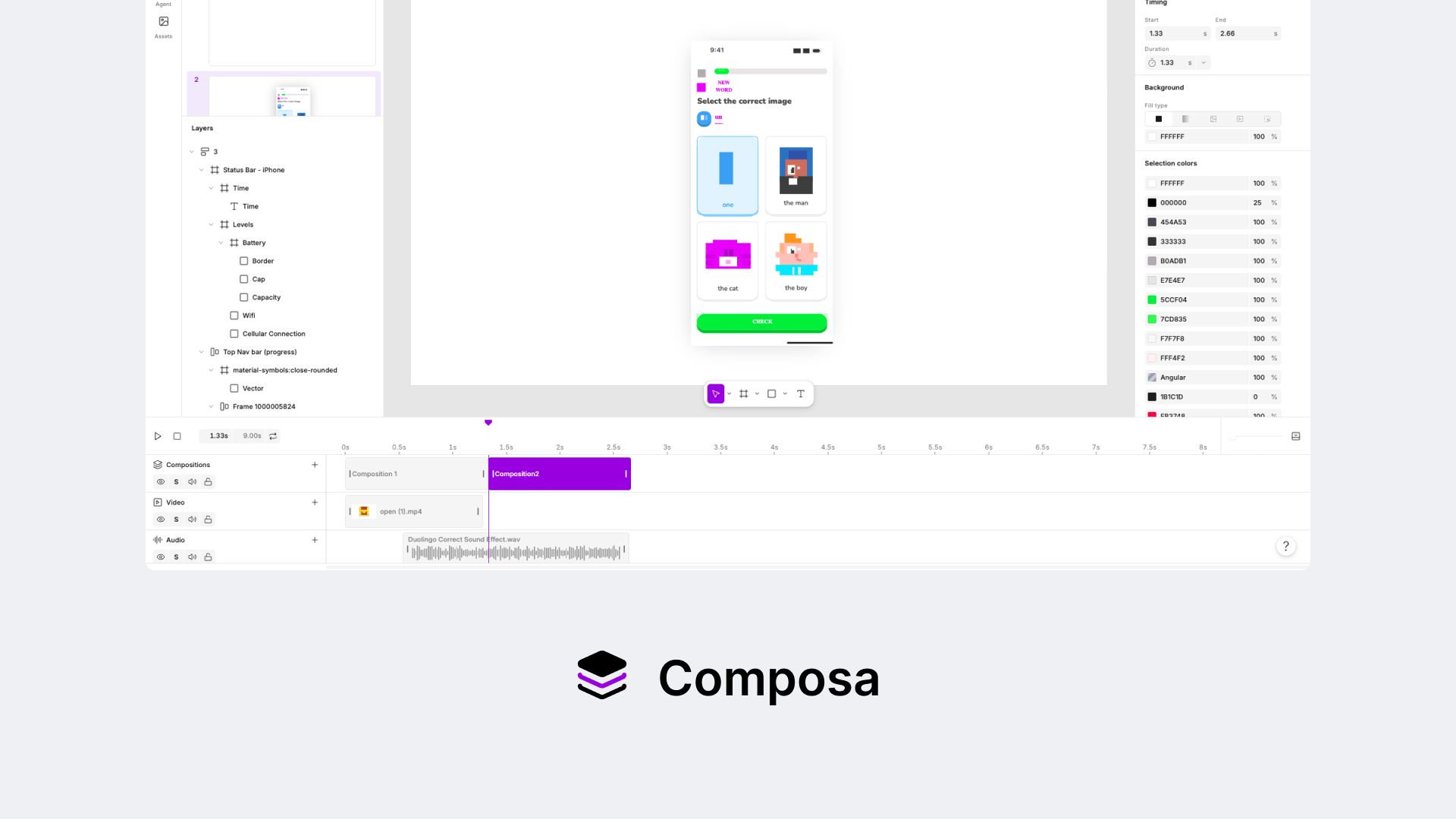
Arrange layers with the same canvas controls, layout models, and property panel designers expect from a design tool.
Composa · Web · 2026
Composa is built on a simple belief: the skills designers use in Figma or slides should carry over to video editing.
The problem
Two things break when designers move into video. Their Figma or slide-making skills no longer map to the editor, and the design itself becomes a flat asset without its original layers or controls.
The product
Composa keeps the canvas and property controls designers already know, then adds the timelines and media tools needed for video.
01 · Compose
Arrange layers with the same canvas controls, layout models, and property panel designers expect from a design tool.
02 · Add media
Place compositions, video, and audio on separate tracks under one playhead.
03 · Animate
Start with Build in, Action, and Build out, then use the motion gizmo, keyframe diamonds, easing, and property controls to refine the result.
04 · Direct
Describe a change and Composa applies it to the canvas or timeline. The result stays editable.
Key decisions for V1
The first version was centered on one flow: paste a design from Figma, add video and audio, animate it, and export one video.
The canvas, layers, property controls, and motion presets should feel familiar before someone learns anything new.
Figma-to-video parity is the direction. V1 earns it by making the design, media, motion, and export loop coherent end to end.
Competitive research
I studied design, slide, video, audio, and AI tools to understand the wider market. The research surfaced emerging behaviors and jobs Composa could support after proving its first editing loop.
Designing media for V1
The canvas and timeline established the editing model, but a credible video editor also needs media and audio effects. I used Sequence as a reference and translated its controls into Composa’s design system.
Translate the useful controls from the reference into a system that belongs beside Composa’s canvas properties.
Give audio the same legible, direct-manipulation model as the rest of the editor.
Where it stands
Composa is live at composa.app and available to use now. I am tracking how designers use the public beta as I decide whether to keep growing it as a side project or turn it into an open-core, founder-led business.
Reflection
Building Composa changed how I think about choosing a market and how much product one person can now direct. I want to make those lessons useful beyond the editor through an open-core model and by writing about the process.
I saw a gap between design and video, then built a public product people could try. The strongest signal comes from putting the idea in front of the market.
With agents, clear specs, design-to-code workflows, and review gates, I recreated Figma-level interface fidelity without its codebase. AI did more than write code; it expanded the range of work one person could direct.